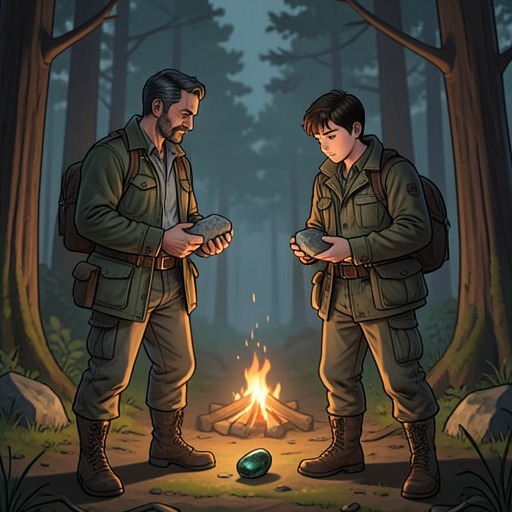
Carver’s inquiry to Te Rau Tauwhare about Wells’s whereabouts
The LuminariesFrancis Carver’s inquiry to Te Rau Tauwhare turns the search for Crosbie Wells into a paid exchange of information, witnessed by Ah Sook and later explained to him by Tauwhare. The bargain sends Carver toward Wells’s home in the Arahura Valley, but its significance reaches beyond the immediate pursuit: it joins a private friendship and a commercial transaction to the contested ownership of land from which Poutini Ngāi Tahu had already been dispossessed.
The land behind the inquiry
Tauwhare belonged to Poutini Ngāi Tahu, whose people had once held the western coast of the South Island. Six years before the encounter, the British Crown purchased an extensive tract for three hundred pounds, leaving the iwi with the Arahura River, parts of its banks, and a small parcel at Mawhera. What had seemed unfair in the negotiations had come to seem unmistakably like theft. Gold-seekers subsequently paid for prospectors’ licences and land, while the value of the gold in the rivers and sands remained beyond calculation. The transaction over Wells’s address takes place within that unequal economy: information about a settler’s home has a price, while the much larger value of the land and its resources has been claimed elsewhere. Crosbie Wells had paid fifty pounds to the Crown for one hundred acres at the eastern end of the Arahura Valley, land thick with tōtara. He built a one-room cottage overlooking the river, cleared a garden, and began a timber mill. Tauwhare frequently travelled through the valley as a hunter of pounamu, and his acquaintance with Wells began after he heard Wells’s axe splitting kindling. Their visits became a tradition. The address Carver wanted was therefore not merely a location: it was the home of a man who had become Tauwhare’s friend, on land whose legal purchase did not settle Tauwhare’s sense of belonging to the valley.
The bargain on the waterfront
Ah Sook first sees Carver speaking with a young Māori man near a grocery store. Their distance from one another makes them look like affiliates rather than friends. Ah Sook cannot hear their conversation, but reads its quick exchanges, the other man’s emphatic gestures, and his repeated shaking of the head as signs of bargaining. Carver eventually counts coins into the man’s open hand. The conversation changes: the man begins to explain something at length, and Carver repeats the information back, apparently to fix it in his memory. They shake hands and part, Tauwhare heading east toward the mountains and Carver west toward the river mouth and the quays. The visible payment is only the surface of an arrangement made months earlier. Tauwhare tells Ah Sook that Carver had offered a reward for news of a man named Crosbie Wells. After Carver returned to Dunedin and Tauwhare went to Greymouth, their paths separated. Tauwhare later met Wells by chance and became his close friend, learning that he lived in the Arahura Valley and had turned from prospecting to building a mill. On the morning of 14 January, Tauwhare encountered Carver on the Hokitika waterfront. Remembering the old offer, he approached Carver and proposed that he could provide news of Wells for a fee. Carver’s offer still stood; they settled on two shillings, and Tauwhare gave him Wells’s location.
Ah Sook follows the information
Ah Sook considers following Carver from a safe distance, but chooses not to force a reunion while unarmed. He suspects Carver may have a knife and perhaps a firearm, and judges that confronting him at a disadvantage would be foolish. Instead, he follows Tauwhare, whose eastward route leads back toward the Arahura Valley. Tauwhare is on his way to build a bird trap; he has just bought several yards of strong fishing line and a small loaf of hardtack to crumble into bait. The ordinary errand makes the exchange feel incidental, even as the information he has sold may expose Wells to danger. Ah Sook catches up with Tauwhare in the next block and takes hold of his sleeve. He asks what Carver wanted and offers a coin in return for an explanation. Tauwhare accepts it and recounts the earlier offer, his friendship with Wells, and the renewed bargain that morning. Ah Sook had not understood the waterfront conversation by watching it alone; the follow-up gives him the identities and history behind the gestures. The account also clarifies that Tauwhare did not simply happen upon Carver that day: he recognized an opportunity to earn money from a reward Carver had placed months before.
Consequences and significance
The information is not immediately useful to Ah Sook. He thanks Tauwhare courteously and leaves without pursuing Carver, whose location and possible weapons still make an encounter risky. Returning to Kaniere, Ah Sook finds Anna Wetherell waiting in a patch of sunshine beyond his door. The reminder of his troubled past leaves him feeling tender toward her, and he gives her half an ounce of fresh opium resin before they lie down together until dusk. His attention thus turns from the knowledge he has just acquired to a small act of present intimacy; the information about Carver and Wells remains unresolved in this moment. The bargain also gives Tauwhare’s later anger over the valley a concrete setting. After Wells’s death, Edgar Clinch legally purchases the acreage and strips the cottage of what can be sold, without having first made the valley his home or worked the land. Tauwhare objects to treating land as currency and to ownership detached from use, care, and labor. Against that view, his sale of Wells’s address is a compromised act: he has been paid by Carver to disclose the whereabouts of a friend, while the place at stake belongs, in Tauwhare’s understanding, to a larger history of dispossession. The scene does not resolve that conflict. It makes the cost of the information legible: two shillings buy Carver a route to Wells, but neither payment nor legal title can erase the relationships and claims embedded in the valley.